понедельник, 16 июня 2014 г.

Cooperative Learning: Assigning Roles to Group Members.

"There are many reason for students to work in small groups in any class, but when the focus is on teaching them a language, the need to do so multiplies."
                                                                                           Gena Rhoades

Using group work in teaching a foreign language is essential, because it gives every student the opportunity to speak more than the teacher does. To organise this work effectively it's good to assign various roles to group members.

 WHY ASSIGN ROLES? 

There are three main reasons for assigning roles to group members.

1. First, this is the best way to solve the 'lack of control' problem, which quite a lot of teachers are afraid of. Giving students such monitoring roles as topic monotor, participation monitor, language monitor etc. makes the teacher sure that students:
- participate equally;
- stay on task and not just idle time away
- speak a foreign language;
- don't make too much noise etc.

2. Second, assigning roles the teacher may help the students organise their work more effectively: ask for help when it is necessary, keep with the time limit and follow the instructions. Here such role as time keeper, errand monitor and leader will be of great use.

3. Third, if students are doing a project that involves several kinds of activities it will be good to distribute the tasks between the group members so that  thier individual differences were met and they would get the desired result together.The roles to be used are those of the recorder, the presenter, the designer etc.

ROLES' TASKS

Here is the description of every role mentioned above and some more.

TOPIC MONITOR - the task of the student with this role is to keep the group on topic. Whenever the students forget the focus of the task and start discussing other things, this is the responsibility of the topic monitor to bring them back to the task at hand.

VOLUME MONITOR - this student is in charge of keeping the volume  of the group low so that they shouldn't interfere with the other groups' work. 

LANGUAGE MONITOR - this role is to remind the students to use the target language and not to switch to their native one. 

PARTICIPATION MONITOR - the student in this role makes sure everyone participates in the discussion and no one dominates it.

TIME KEEPER - the student is given a stop-watch and announces when the time for the whole task or a step is halfway through and when it's nearly up

ERRAND MONITOR - the role is to get supplies and the teacher for help whenever the group members find they don't have the resources to solve the problem.

LEADER - focuses work around the learning task, distributes the tasks between the group members, makes sure every voice is heard.

ASSESSMENT RUBRIC EXPERT - sees that all group member are familiar with the assessment rubrics provided by the teacher and checks if the work being done meets all the requirements.


RECORDER - compiles group members' ideas on a collaborative graphic organiser and writes on the board for the whole class to see during the presentation.

PRESENTER - this role is for presenting the groups' finished work to the whole class.

DESIGNER - the student with this role is responsible for the artistic side of the project.

 
DEVIL'S ADVOCATE - raises counter-arguments and (constructive) objections, introduces alternative explanations and solutions.


HARMONISER - strives to create a harmonious and positive team atmosphere and reach consensus (while allowing a full expression of ideas.)


PRIORITISER - makes sure group focuses on most important issues and does not get caught up in details.
CHECKER - checks to make sure all group members understand the concepts and the group’s conclusions.


WILDCARD - assumes the role of any missing member and fills in wherever needed.


This is not the final list of possible group roles. Depending on your purpose, kind of project, number of studens in a group and individual learner differences you may think of many other ones.
For example, if the task is to make and present a recipe, one of the roles may be that of a cook. This student will be miming the actions while others are presenting the recipe.
Here you can find a sample set of group role cards that tell each student what their role is, what their functions are and what vocabulary can be useful for this role.


воскресенье, 15 июня 2014 г.

Noun-Adjective Collocations Where 'Big' Would Make a Mistake

Here is a kind of infographic that shows noun-adjective collocations. Non-native speakers tend to use the word 'big' with these nouns to denote a large degree or amount. However, this word can't be used with any of them. I not only gave a different colour to each noun but also coloured those adjectives that collocate with several nouns. For example, the adjective 'good' is orange and you can easily see that it agrees with the nouns: variety, range, experience and progress.

четверг, 12 июня 2014 г.

Lesson Plan: Future Plans with 'Going to'

Here is a lesson plan that was made as a final project on the teacher training course
 "Paths to Success in English Language Teaching"
 sponsored by the U.S. Department of State and the University of Oregon


A. Students and Setting

Students:

Adult students with beginner - elementary level of English proficiency. They have done a beginner course and are taking the elementary one at the moment.


Setting:

A private linguistic school where students study English as a foreign language. There are 12 students in the group. We meet twice a week for 4 periods of 45 minutes in the evenings. Students are also expected to do homework outside the classroom.


B. Lesson Background:

Student are studying the module “Day Off”. They have already learnt some vocabulary on the topic (have a barbecue, have a family meal, relax at home etc.). At this lesson they are going to learn how to speak about plans for the weekend with the structure 'going to'. At the next lesson the structure will be compared with 'want to' and 'would like to' and practised while speaking about travel.


C. Learning Objectives/Expected Results:

As a result of the lesson the student are expected to learn how people speak about their future plans in English.

First, the structure will be presented in meaningful context. Then, students will listen to native speakers talking

about their plans. After that they will speak and write about their own plans for the weekend and find out about other people's plans.


D. Materials and Sources:

Materials

  1. A drawing of a young man with thought bubbles over his head (may be drawn on the board or shown with the projector).
  2. Video worksheets (1 per student).
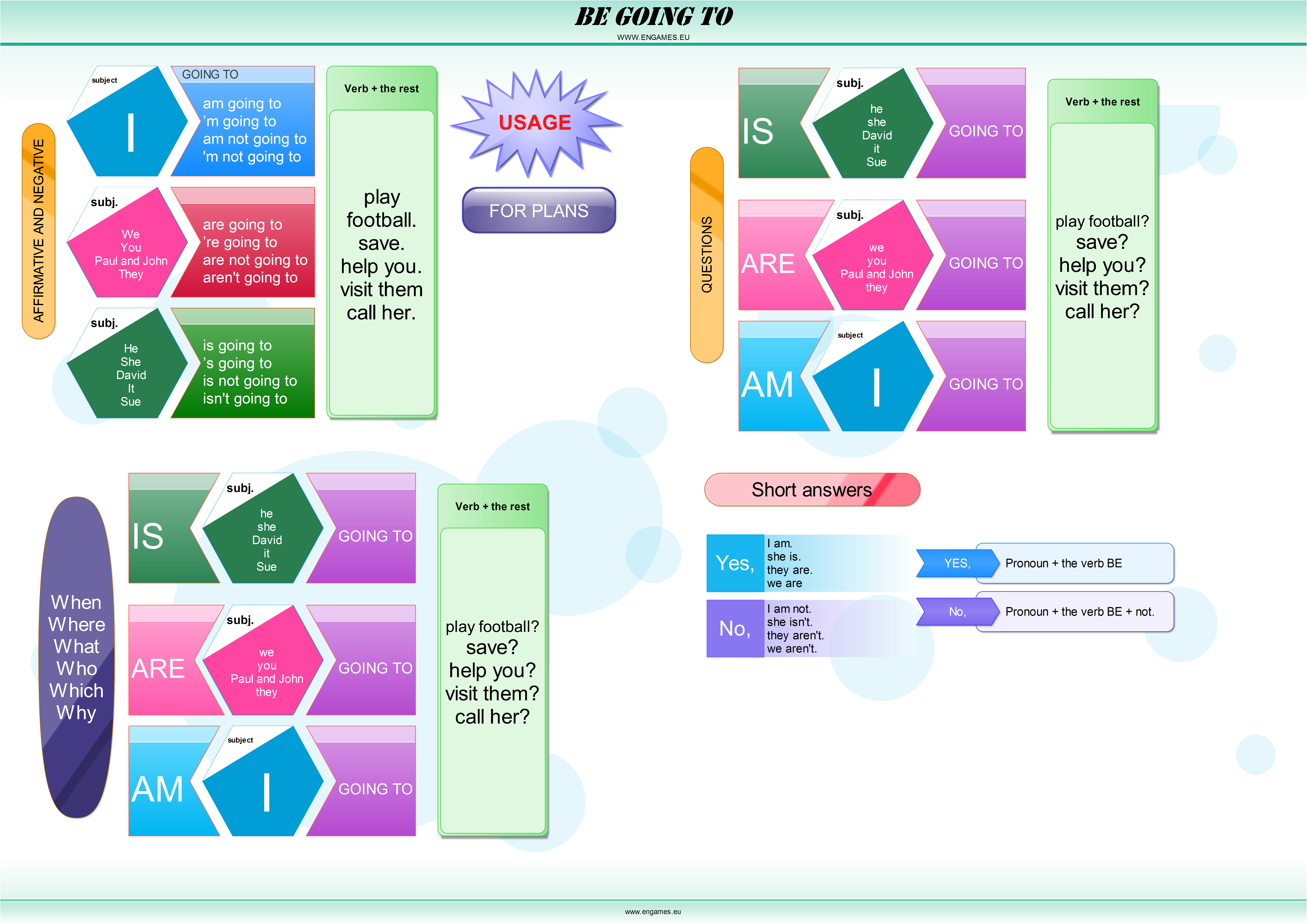
  3. A table showing an affirmative, negative and interrogative form of 'going to' (may be drawn on the board or shown with the projector). 


Sources

1) A youtube video:


2) Scrivener, J. (2010),Teaching English grammar. What to teach and how to teach it. (Macmillan Books for Teachers).

Optional materials and sources:
1)   infographic for 'going to'
2) online games for 'going to'


E. Procedures / Timing:


Teacher does/says . . .
Students do/say . . .
Approximate Time
Hi guys! How are are you? How was your weekend? Did anyone have a barbecue, a family meal or a party? Did anyone dance in a club? Did you just relax at home?
And what are your plans for the next weekend?
This is what we are going to do today – learn to speak about our future plans and find out what our fellow students are planning to do.
Greet the teacher, speak about their last weekend.


Probably, have some problems with expressing the ideas. May ask for help.
3min
- Look at the drawing and say why Matt is smiling. Can you say what he is thinking?
- Listen to my model and continue: 'I'm going to walk into town. I'm going to buy a present for Marie.'


- Repeat all the sentences after me
- What structure helps us speak about our future plans?
Look at the drawing, guess he is thinking about his plans for this weekend.
Listen to the teacher's model and say what else the young man is thinking.
  • I'm going to have a snack in McDonald's
  • I'm going to go to Marie's birthday party etc.
Repeat the sentences chorally.

I'm going to
5 min.
In all of these sentences is the action in the past or in the future?
Has Matt already decided to do the actions?
When did he decide about them?
What do you think will change if we speak about plans of a sister, a brother, several friends etc.?
Look at the table and say how we make a negative sentence and a question about someone's plans for the future. What do you think short answers will be like?

In the future

Yes
Sometime in the past

The verb 'to be' will agree with the subject.
Study the table and answer the teacher's questions
5 min
Let's watch the first two episodes of a video (0- 1.07) in which people speak about their future plans and do tasks 1 on your video worksheets. Marina, could you hand out the worksheets while I'm starting the computer.
Let's check and practice the exchanges in chorus: “What are you going to do tonight, Alice? - I'm going to work in the yard”, “What are you going to do tonight, Fred? - I'm going to fix my car” etc.
Now row 1 asks the question and row 2 answers.
Work in pairs. Ask each other about your real plans for this evening.


One student gives out the worksheets.
Watch the video and do task 1.
Check with the teacher, then repeat chorally


Practice in chorus

Work in pairs
7 min.
How do we speak about a plan to go somewhere?
Yes, but there is another way. Let's watch the next 2 episodes (1.08-3.14)
and do task II on the worksheets.
Let's check.
Paraphrase my sentences:
I'm going to go out for dinner
He's going to go to chemistry class
They are going to go to the beach” etc.
Are you going to go somewhere in the nearest future. Tell us about your travel plans in two different ways.
I'm going to go

Watch the video and do task 2 individually.

Check
Answer individually
I'm going out for dinner
He's going to chemistry class
They are going to the beach

Several students answer the question.
7 min.
For what other periods of time can we make plans besides tonight and tomorrow? Watch the next 3 episodes (3.15-7.34) and do tasks III and IV.
Work in pairs: ask general questions about people in the video and give short answers. Ex. “Is Lance going to wash his clothes this week? - No he isn't. He's never going to do this.”
Circulates around the room, observes, helps in case of difficulty

Next week, next weekend, holidays etc.
Watch the video and do task 3-4 individually.
Work in pairs
13
In some cultures people are very organized and may make detailed plans for longer periods of time. At home watch the last episode (7.35-10.08), do task V on the worksheets and write your plans either for each day of next week or for each month of next year

Write down home work.
5 min


F. Alternative Assessment:

The forms of alternative assessment used at this lesson are concept questions (CQ) and observation. The teacher asks CQ after the presentation of the new grammatical structure to check if the students have understood the meaning of the language item. Based on the answers, the teacher decides whether to give some more explanations or pass on to practice. As for observation, it's made while students are practising the language in pairs. When the teacher is circulating she helps students with vocabulary and grammar. Besides, she makes notes of the most common mistakes to draw students attention to later. Thus the observation helps learn and solve the problems that appear when the new structure is used in conversation.


G. Classroom Management:
To motivate students and keep them engaged the teacher has structured the lesson in such a way that


  • watching video episodes alternates with speaking exercises;
  • individual work is followed by choral and pair activities;
  • simple tasks go before more complicated ones.
The teacher gives clear instructions about what students are to do. When students are to work chorally the instructions are supported by gestures that are familiar to students (they have already become part of the classroom routine).
The teacher also asks one of the students to hand out worksheets, which serves to save the time.
H. Reflection - Phase 2

(a) The first lesson plan included only one part of the video clip. This time the whole lesson is based on the video and I have prepared tasks for every episode. In this way I made the lesson plan more interactive, with a better use of integrated skills and a better provision for individual learner differences.
(b) This lesson demonstrates the use of integrated basic and sub-skills: grammar use, listening, speaking, reading and writing. While the main focus of attention is on a single grammar item all other skills are developed and reinforce each other.

Assessment will be formative as the teacher will get a good sense of how well the new structure is understood and if it is used correctly in conversation. On the basis of concept questions answers and observation results the teacher will decide about the necessity of further explanations and / or practice.
As the class is rather small (12 students) and the students are adults the classroom management is less of a problem. A well-structured lesson plan containing a variety of activities, different forms of work and suitable resources as well as earlier established classroom routines should keep the students engaged and head off any problems.
Students can show their individuality by speaking and writing about their own future plans. Doing their home work, they may choose to write either about their plans for the week (which people in Russia often do) or for the next year (which is less natural for a Russian person and may serve as an attempt to make their lives more organised).