Here is a lesson plan that was made as a final project on the teacher training course
"Paths to Success in English Language Teaching"
sponsored by the U.S. Department of State and the University of Oregon
A.
Students and Setting
Students:
Adult
students with beginner - elementary level of English proficiency.
They have done a beginner course and are taking the elementary one
at the moment.
Setting:
A
private linguistic school where students study English as a foreign
language. There are 12 students in the group. We meet twice a week
for 4
periods of 45 minutes
in the evenings. Students are also expected to do homework outside
the classroom.
B.
Lesson Background:
Student
are studying the module “Day Off”. They have already learnt some
vocabulary on the topic (have a barbecue, have a family meal, relax
at home etc.). At this lesson they are going to learn how to speak
about plans for
the weekend with
the structure 'going to'. At
the next lesson the structure will be compared with 'want to' and
'would like to' and practised while speaking about travel.
C.
Learning Objectives/Expected Results:
As
a result of the lesson the student are expected to learn how people
speak about their future plans in English.
First,
the structure will be presented in meaningful context. Then, students
will listen
to native speakers talking
about
their plans. After that they will speak
and write
about
their own plans for the weekend
and find
out
about other people's plans.
D.
Materials and Sources:
Materials
- A drawing of a young man with thought bubbles over his head (may be drawn on the board or shown with the projector).
- Video worksheets (1 per student).
- A table showing an affirmative, negative and interrogative form of 'going to' (may be drawn on the board or shown with the projector).
Sources
1)
A youtube video:
2)
Scrivener,
J. (2010),Teaching English grammar. What to teach and how to teach
it. (Macmillan Books for Teachers).
Optional materials and sources:
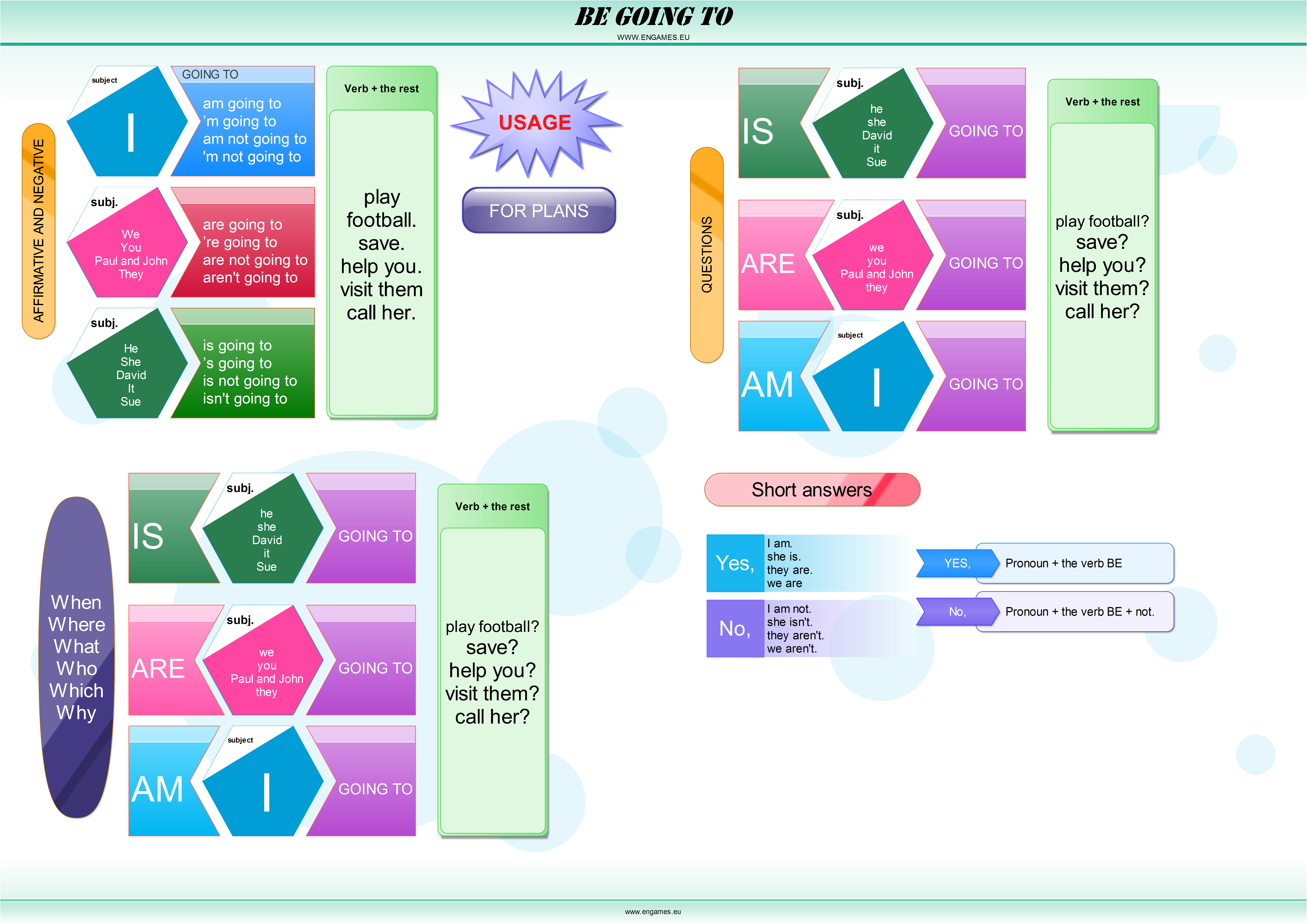
1) infographic for 'going to'
2) online games for 'going to'
Optional materials and sources:
1) infographic for 'going to'
2) online games for 'going to'
E.
Procedures / Timing:
Teacher
does/says . . .
|
Students
do/say . . .
|
Approximate
Time
|
Hi
guys! How are are you? How was your weekend? Did anyone have a
barbecue, a family meal or a party? Did anyone dance in a club?
Did you just relax at home?
And
what are your plans for the next weekend?
This
is what we are going to do today – learn to speak about our
future plans and find out what our fellow students are planning to
do.
|
Greet
the teacher, speak about their last weekend.
Probably,
have some problems with expressing the ideas. May ask for help.
|
3min
|
-
Look at the drawing and say why Matt is smiling. Can you say what
he is thinking?
-
Listen to my model and continue: 'I'm going to walk into town. I'm
going to buy a present for Marie.'
-
Repeat all the sentences after me
-
What structure helps us speak about our future plans?
|
Look
at the drawing, guess he is thinking about his plans for this
weekend.
Listen
to the teacher's model and say what else the young man is
thinking.
Repeat
the sentences chorally.
I'm
going to
|
5
min.
|
In
all of these sentences is the action in the past or in the future?
Has
Matt already decided to do the actions?
When
did he decide about them?
What
do you think will change if we speak about plans of a sister, a
brother, several friends etc.?
Look
at the table and say how we make a negative sentence and a
question about someone's plans for the future. What do you think
short answers will be like?
|
In
the future
Yes
Sometime
in the past
The
verb 'to be' will agree with the subject.
Study
the table and answer the teacher's questions
|
5
min
|
Let's
watch the first two episodes of a video (0- 1.07) in which people
speak about their future plans and do tasks 1 on your video
worksheets. Marina, could you hand out the worksheets while I'm
starting the computer.
Let's
check and practice the exchanges in chorus: “What are you going
to do tonight, Alice? - I'm going to work in the yard”, “What
are you going to do tonight, Fred? - I'm going to fix my car”
etc.
Now
row 1 asks the question and row 2 answers.
Work
in pairs. Ask each other about your real plans for this evening.
|
One
student gives out the worksheets.
Watch
the video and do task 1.
Check
with the teacher, then repeat chorally
Practice
in chorus
Work
in pairs
|
7
min.
|
How
do we speak about a plan to go somewhere?
Yes,
but there is another way. Let's watch the next 2 episodes
(1.08-3.14)
and
do task II on the worksheets.
Let's
check.
Paraphrase
my sentences:
“I'm
going to go out for dinner
He's
going to go to chemistry class
They
are going to go to the beach” etc.
Are
you going to go somewhere in the nearest future. Tell us about
your travel plans in two different ways.
|
I'm
going to go
Watch
the video and do task 2 individually.
Check
Answer
individually
I'm
going out for dinner
He's
going to chemistry class
They
are going to the beach
Several
students answer the question.
|
7
min.
|
For
what other periods of time can we make plans besides tonight and
tomorrow? Watch
the next 3 episodes (3.15-7.34) and do tasks III and IV.
Work
in pairs: ask general questions about people in the video and give
short answers. Ex. “Is Lance going to wash his clothes this
week? - No he isn't. He's never going to do this.”
Circulates
around the room, observes, helps in case of difficulty
|
Next
week, next weekend, holidays etc.
Watch
the video and do task 3-4 individually.
Work
in pairs
|
13
|
In
some cultures people are very organized and may make detailed
plans for longer periods of time. At home watch the last episode
(7.35-10.08), do task V on the worksheets and write your plans
either for each day of next week or for each month of next year
|
Write
down home work.
|
5
min
|
F.
Alternative Assessment:
The
forms of alternative assessment used at this lesson are concept
questions (CQ) and observation. The teacher asks CQ after the
presentation of the new grammatical structure to check if the
students have understood the meaning of the language item. Based on
the answers, the teacher decides whether to give some more
explanations or pass on to practice. As for observation, it's made
while students are practising the language in pairs. When the teacher
is circulating she helps students with vocabulary and grammar.
Besides, she makes notes of the most common mistakes to draw students
attention to later. Thus the observation helps learn and solve the
problems that appear when the new structure is used in conversation.
To motivate students and keep them engaged the teacher has structured the lesson in such a way that
- watching video episodes alternates with speaking exercises;
- individual work is followed by choral and pair activities;
- simple tasks go before more complicated ones.
The teacher also asks one of the students to hand out worksheets, which serves to save the time.
H. Reflection - Phase 2
(a) The first lesson plan included only one part of the video clip. This time the whole lesson is based on the video and I have prepared tasks for every episode. In this way I made the lesson plan more interactive, with a better use of integrated skills and a better provision for individual learner differences.
(b) This lesson demonstrates the use of integrated basic and sub-skills: grammar use, listening, speaking, reading and writing. While the main focus of attention is on a single grammar item all other skills are developed and reinforce each other.
Assessment will be formative as the teacher will get a good sense of how well the new structure is understood and if it is used correctly in conversation. On the basis of concept questions answers and observation results the teacher will decide about the necessity of further explanations and / or practice.
As the class is rather small (12 students) and the students are adults the classroom management is less of a problem. A well-structured lesson plan containing a variety of activities, different forms of work and suitable resources as well as earlier established classroom routines should keep the students engaged and head off any problems.
Students can show their individuality by speaking and writing about their own future plans. Doing their home work, they may choose to write either about their plans for the week (which people in Russia often do) or for the next year (which is less natural for a Russian person and may serve as an attempt to make their lives more organised).

Комментариев нет:
Отправить комментарий